
Beginning here is a list of hotels that have existed or are currently existing in Deniliquin, this list will be updated over time.
Records have been patchy with the life and death of hotels falling through the Historical gaps, there may be some errors as reports were prone to be inaccurate with names and even places being incorrectly reported for example Robert Johnston at the Commercial Hotel was also recorded as Robert Johnson.
The aim at this present time is to get as much pre-1950 history as possible and then slowly move forward towards the 21st century.
Bendigo Hotel
There were two Bendigo Hotels, both were on Cressy Street but in different years.
Cornelius Toohey ran the Bendigo Hotel opposite the Castlemaine Hotel; the hotel was closed sometime around late February or early March 1879, and Mr. Toohey left the local area before that time.
The license was cancelled in March 1879 after Mr. Toohey was charged with abandoning his licensed house.
The hotel was auctioned off in July 1879 but was passed in at £200.
Alexander Steavenson applied for a license for the hotel in September 1879, Superintendent Brown objected on the ground that the house was no longer required, and the application was refused.
An article in the Pastoral Times from 1936 indicates that the hotel was where Miss Maher’s shop was.
Castlemaine Hotel –> Bendigo Hotel
Bendigo Hotel existed on spot of Laughing Chicken until the early 1920’s when it was de-licensed.
James Jackson founded the Castlemaine Hotel in 1877, he had come from Castlemaine where he was a butcher for six years.
In 1879 there was a report that a woman was put on trial for having a ‘Bawdy house’ next to the Bendigo.
F. Bassett was granted a Billiards license in 1880 and again in 1881.
F. Bassett transferred the license to Johanna Kerr on March 15, 1883, and Johanna Kerr would hold the license until 1885.
The license of the hotel was transferred from Johanna Kerr to Emma Irvine on June 19, 1885.
The Billiards license of the hotel was transferred from Johanna Kerr to Emma Irvine on June 27, 1885.
Emma Irvine transferred the license to Thomas Collins on January 19, 1886, before Mr. Collins transferred the license to Charles Rowbottom in May 1887.
William White was the listed publican in 1892 and the last available record last had him as Publican in 1910.
In November 1912, the Lester family brought the hotel from the estate of William White for somewhere around £1800 and the building was let to Frank Trist who occupied the building in December 1912.
In July 1914 you could buy the following from the Hotel
Watson’s No. 10 for 5s and 6d
Dewat’s Imperial for 5s and 6d
Claymore for 5s and 6d
Mitchell’s Crown (large) for 6s and 9d
Mitchell’s Crown (small) for 3s and 6d
Hennessy’s Three Star Brandy for 8s and 0d
Hennessy’s One Star Brandy for 6s and 6d
Wolfe’s Schnapp’s for 5s and 6d
J.D K Z Gin for 6s and 3d
Gilbey’s Dry Gin for 5s and 6d
English Ale (large) for 1s and 6d
Guinness Stout (large) for 1s and 6d
Beck’s Lager (large) for 1s and 6d
Mr Lester was the listed Publican in 1916 until 1919 and was followed by William Joseph Bott for nine months in 1919 before the publican was Alfred W Butcher in 1920.
Mr Lester was fined £5, with 6s costs in May 1919 for allowing drunkenness at the Bendigo Hotel.
Mrs. Lester died in April 1919.
The hotel in March 1919 had a bar, three parlors, eight bedrooms, dining room, kitchen, washhouse, bathroom, a four-stall stable, buggy shed, chaff house, outhouse, underground dining room and two cellars.
Ads in the 1921 papers indicated that Robert McKinlay had taken an extended lease of the hotel, ads of that year also state that the hotel had ‘First Class Table’ and ‘Good Accommodation’.
It is reported that H.G Winter sold the license of the hotel to John Herbert Charleston and he had a lease up to May 31, 1924, but the hotel was one of the hotels that was forced to close down by June 30, 1922.
Ads appeared weekly in The Independent until the February 10, 1922, edition of the paper.
Drinkers at the Hotel drank Abbotsford Ale and advertisements declared that the hotel had the ‘Best Wines and Spirits’ and ‘Good Stabling and Yards’.
It was announced in April 1922 that executors of Mrs Lester’s estate received £1260 and Mr Charleston received £460 in compensation for the withdrawn hotel license.
The hotel was passed in at auction in June 1922, it had reached £600.
The Hotel in 1922 was said to have 16 rooms (mainly brick), Washhouse, Laundry, Stables and Buggy Shed etc.
Mr Lester moved on to Jerilderie and was there in February 1923 when a furniture sale was conducted on his behalf.
The building was sold in 1937, the building was described as consisting of a brick Billard room measuring 21 x 23ft; a cellar, 10 rooms; six of which are brick; sitting room, dining room, kitchen etc. The brick portion of the building was reported as being solid and well-built and was believed it could he altered to suit almost any class of business
A fire broke out in a shed at the rear of the building in March 1940, the former hotel was described to be an apartment house.
When the demolition of the Hotel occurred is unknown though the hotel was mentioned in 1942 as the brick footpath in front of the building was in disrepair and the question was asked who was responsible for it.
Bridge Hotel –> Central Hotel
Considered one of the oldest hotels in Deniliquin, the Central was originally the Bridge Hotel.
The license for the hotel was granted in 1865 to John Taylor, the license was then given to John Edmondson and then to Robert Pyke in 1867.
Albert Elliott held the publican’s license to the hotel until 1868 when it was transferred to William MacDonald.
Alexander F. Steavenson (1877-1878)
James Ashton transferred the license to George McLeod on April 14, 1882.
The hotel was purchased by Mr Ernstsen for £900 in September 1882 and Mrs. Mahon was to shortly occupy the hotel.
George McLeod transferred the license to John Lamb on October 3, 1882.
John Lamb transferred the license to A. Lonegren on February 17, 1883.
A license for the hotel was issued to Thomas Collins on July 19, 1884.
Thomas Collins transferred the license to Catherine Collins on April 29, 1885.
Catherine Collins transferred the license of the hotel to Mary Ann Moseley on May 15, 1889.
Daniel Foley was the next to hold the license before the license was transferred to James Loy in 1892.
A bedroom at the rear of the hotel caught fire on March 21, 1905, it was quickly brought under control.
In 1906, the annual rental value of the hotel was put down as L104 and a license fee of L25.
In 1911, the license was transferred from John T. Bouchier to Thomas Daly.
A young man was fined for insulting language in 1925 after he insulted a woman who was on the side veranda as she was boarding at the hotel.
In 1929, the Central was called upon to have the premises sewered along with two other Hotels in the area.
George Guy transferred the license to the hotel to Walter Bott in February 1930 ending George’s eight years at the hotel.
In 1932, A man was fined for being found walking through the yard of the Hotel with a bottle of beer on a Sunday.
In 1933, Arthur Leslie Bott was fined for having the bar open on a Sunday and four others were fined for being on the premises during prohibited hours.
In 1936, Arthur Bott transferred the license to Gerald Duncan Munro.
The Age newspaper reported in February 1940 about the Central Hotel being rebuilt into the building it is today.
The rebuilding of the hotel gave it 12 more bedrooms, a bar, three Parlors and a lady’s lounge.
Licensee James Hall died at the hotel on November 4, 1940, at the age of 64.
Frances Hall was given the license of the hotel in 1941, Norman H. Hall was later the proprietor of the hotel, and the telephone number was 60.
The horse String Band died at the hotel’s stables in 1950; String Band was a winning horse in the district including winning six races in a row.
Gerald Duncan Munro died in Deniliquin on May 5, 1954, at the age of 74, his death was reported in The Age and called him a ‘Deniliquin Identity’.
Rich River Poultry started in the backyard of the Central Hotel in 1957; it later moved to Hay Road before ending up at Echuca-Moama.
George Francis Hall and twenty-three others were fined in December 1961 after they were caught being in the hotel on August 27, 1961, which was a Sunday.
George Francis Hall transferred the license of the hotel to Mr. Francis Gibbs on January 23, 1963.
The Central Hotel continued to operate into the 21st century before closing and was turned into housing though the outside has signs for the bottle shop next door, occasionally a truck tips over nearby and ends up in front of the former hotel.
The House That Jack Built –> Pyke’s Hotel –> Union Club Hotel
The Union Club Hotel existed on the corner of George and Napier Street but before its demolition it had lived a life as two other hotels, The House That Jack Built and Pyke’s Hotel.
John Gibson applied for a publican’s license in November 1865 for his newly erected premises in Bridge Street (now Napier Street) with the hotel opening on November 23, 1865.
Robert Harvey Pyke drowned in North Deniliquin in 1879 despite attempts by workers of the Brick-kilns to rescue him.
After Robert Harvey Pyke’s death, Mary Pyke taken over as Publican and was listed in the role until Charles J. O’Brien was listed in 1883.
Bessie King was the listed Publican in 1884 and Mary O’Brien (formerly Mary Pyke) was listed in 1885 until 1887.
The Hotel burnt down in March 1887, all was left was ‘bare walls and charred remains of furniture and woodwork.
The hotel prior to the fire was made of wood with the extensions of the building being made of brick which surrounded the woodwork.
An inquest into the fire was held on March 25th, 1887, but no evidence to show how or in what manner the fire originated was found.
Mary O’Brien was charged with not conducting her licensed premises with the court case starting on November 8, 1887, it was adjourned to November 21st that year.
Mary O’Brien transferred the license of the hotel from herself to Matthew Hole on November 14, 1887.
Jane Hole gave birth to a daughter at the hotel on September 19, 1888.
Matthew Hole transferred the license of the hotel to Catherine Collins on May 15, 1889.
Catherine Collins transferred the license of the hotel to A. A. Smith on March 5, 1895.
John Morran became the next Publican in 1898 and was replaced by John S. Haid in 1899 and he was replaced by Thomas Collins by the time the Government Gazette came out in August 1900.
In 1903, Mr J. Kelly as auctioneer leased the hotel to Mr M. Kennedy who also became the Publican.
An ad in 1904 advertised the Hotel as having fourteen rooms, substantially built of brick and wood.
In 1905, the Hotel and four other brick and weatherboard shops were sold for £1050 to James McKenzie, that same year Katherine L. Hennessy was the listed Publican.
Robert Baxter replaced K. L. Baxter (nee Hennessy) on June 6, 1906, and later that year was charged with allowing a person on premises during prohibited hours, allowing another person on the premises without lawful excuse and gaming but all three charges were dismissed in court.
Newspaper ads in 1910 announced that Thomas Keane had a lease of the hotel, these ads ran well into 1911.
Thomas Keane transferred the license of the hotel to James McKenzie in November 1913.
James McKenzie sought and received permission in August 1914 to do some building at the hotel that required bricks to be stacked on the footpath under the supervision of the works foreman.
James McKenzie was fined in 1919 for allowing John Kelly into the premises at a time the hotel should not be open for the sale of liquor, this case was appealed, and the conviction was confirmed in April 1920.
James McKenzie’s license for the Union Club Hotel was cancelled on June the 2nd 1920 after breaking the Liquor Act three times with three years.
John Herbert Charleston was granted a license to run the hotel in June 1920.
Thomas Collins was the last licensee of the Union Club Hotel in June 1921, and he was later compensated a sum of £290 and James McKenzie was compensated £830 for the Hotel’s closure.
The Hotel was closed on June 30, 1922, with the last ad in The Independent published on the same day.
The former hotel building was brought in August 1936 by Mr T. A. Bradford who called for tenders for the demolition of the building, this process was closed on September 7, 1936.
The Deniliquin Motor Company building that replaced the Union Club Hotel still stands today.
Dublin Hotel (Napier Street)

The Dublin Hotel building while it has stopped trading as a hotel in 1922 is still standing in Napier Street.
The Dublin Hotel was originally established in Cressy Street instead of the Napier Street address that most people know about.
Hotel landlord Stephen Mullen died on March 24, 1877, after falling from a vehicle near the White Lion and was run over, the inquest into his death weas held at the Dublin that same day.
Stephen Mullen funeral was held on March 25, 1877, with the procession leaving the hotel at 3pm that afternoon.
In 1877 a lamp outside the Dublin Hotel was damaged during a series of property damage on Hotels in Deniliquin at the time.
Charles Blacket Harrison was the next publican when the license was transferred to him from Elizabeth Mullen.
Mr. Harrison was summoned to court in 1878 and was charged with permitting gaming in his licensed house, the charge was dismissed.
Mr. Harrison died on February 19, 1880.
In 1880, a report in the newspaper reported that ‘an hotel is being built by Messrs. Hunter and Sons for Mrs. Harrison, of the present Dublin Hotel, and it is expected to be completed next month’.
This explains why the first couple of years of the Hotels existence the hotel at Cressy Street had before it was listed at Napier Street where it stayed until 1922.
Neil Mackenzie died at the hotel in September 1882 after his horse shied at a cab resulting in him falling, he was taken to the hotel and died early the next day.
A man died at the hotel in December 1884 after falling down the steps the previous day.
A ‘smart girl’ was wanted as a cook for the hotel in September 1885, applications were given to Mrs. Brophy.
John Bott became licensee of the Dublin in 1890 after leasing the building from Mr Brophy.
The Dublin Hotel was lightly damaged by fire in November 1892 and was sold for 2200 pounds in 1897 to Elliott’s Riverine Brewery Co.
The Dublin was described as having 18ft of frontage, a bottom floor made of brick whilst the top floor was made of wood.
In 1906, John Bott was brought to court on the charge of having two people on his premises on Sunday October 21st 1906.
Also in 1906, the hotel’s annual rental value was judged to be L130 and the licensee fee was L25.
John Bott was noted in 1916 as celebrating 26 years as the licensee of the Dublin and would continue to run the hotel until it was closed.
William J Bott taken over from his father as licensee in March 1921 (or 1920).
A report in December 1921 revealed that two of the hotels’ rooms were condemned by the Board of Health.
An auction was held on July 6, 1922, to sell all items from the Hotel as it was de-licensed that year.
In September 1922, the building was transferred from Elliott’s Riverine Brewery Co to Mrs G. T. Helsby.
A Municipal meeting in 1925 raised the question about the box drain at the back of the ‘Old Dublin Hotel’.
William J. Bott tragically passed away at the age of 38 due to illness in October 1928 and John Bott died in August 1927 at the Sportsman’s Arms Hotel.
Federal Hotel (Still Standing)
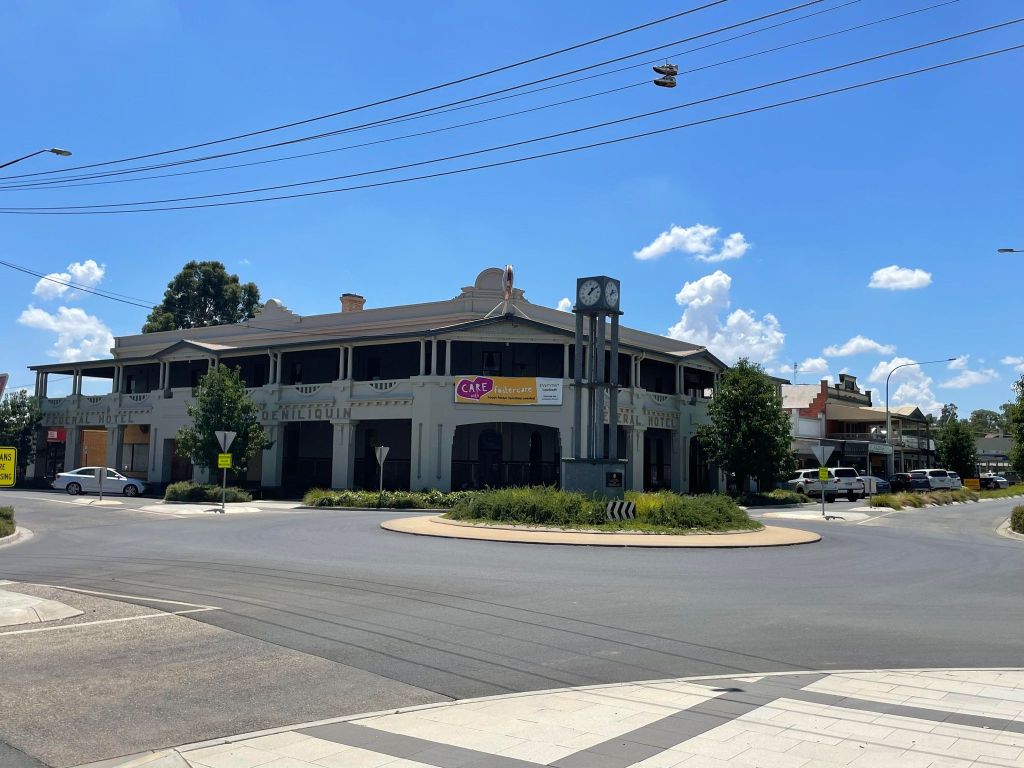
The Federal Hotel replaced the Black Swan Hotel after the fire in 1896.
It was opened in 1897 and was run by Mr John Geraghty.
John Andrew McInnes held the license until 1912 when James Hall taken over and held it until 1926 before making way for James Robinson.
In 1915, James Hall was charged with not having a light on outside his premises and was fined 5s with 6s costs.
In 1921 James Hall was charged with having a person on the premises at a time the hotel was prohibited from serving alcohol, the charge was withdrawn.
The Hotel breached the Gaming Act in 1922 and James Hall was fined.
It was reported in April 1924 that repairs ordered for the Federal Hotel had not commenced and they had to be carried out.
Frank Robinson brought the hotel from Mr. Jas. Hall in 1926 and would own it for the rest of his life.
The Federal Hotel has changed shape over the years with the brick veranda added after 1927 though you can see the pre-1927 structure if you look from the war memorial.
Frank Robinson was fined in 1929 for keeping his premises open for the sale of liquor in prohibited hours.
Frank Robinson died at the age of 45 in June 1932 in Melbourne and his remains were returned to Deniliquin for burial.
In 1933, a youth was seen leaving the hotel and going to a dance at the Masonic Hall, he was found with two bottles of draught and the court fined him £1, with 8/ costs.
In 1941, the licensee Mrs I. Robinson sought an extension of time allotted in which to repair the balcony of the Hotel, the balcony repairs were ordered to be carried out in 1939.
In 1946 a cook was wanted with the offer of award wages; good conditions and they could live at the hotel if required.

Francis William James Robinson died at the age of 26 on the 27th of April 1947, he had taken over the license of the hotel after the death of his mother eleven weeks earlier.
David J. Prior was the licensee in 1948 according to an advertisement and the Hotel’s phone number was 202.
In 1956, the Gibb and Beeman’s famous Travelling Consulting Room was regularly set up in the hotel with one instance being on April 27 and 28 of that year.
The 1950’s saw the license go to Fredrick Muller who had it until 1962 when Desmond Cochrane Hempton was mentioned as managing the hotel from May 15, 1962, to July 6, 1962.
The hotel’s top floor received a facelift of its interior in 1962, this included painting and the installation of new wallpaper.
It is assumed that Mr Muller held on to the license until Neil Malcolm Cooper obtained it on June 21 1965 and held it until November 30 1967 when Dennis Todor became licensee.
The Hotel for decades served as the meeting place of the Deniliquin Licensed Victuallers Race Club (LVRC).

There have been fears in recent years that the Federal would be demolished but thankfully it was brought and retained for future use.
In 2018 a website detailing a plan to turn the Federal Hotel into a cinema and other shops and businesses went offline after fundraising got around 70% of the way to completion.
In 2019, vandals caused water and physical damage to the hotel by running the taps and smashing mirrors and walls despite the efforts of a caretaker to keep the hotel clean and intact.
It was announced in September 2019 that the hotel has a new owner, and this owner has plans for the building to the benefit of the community.
Work commenced on the façade of the hotel in March 2020 with locals expressing relief after the old hotel had been through so much since it was last occupied.
Pictures taken in 2021 of the hotel’s interior were published in the 5pm – Midnight section of “A Day in the Life of Deniliquin“
Terminus (1876-1891) – -> Drover’s Arms (1892-98) –> Oddfellows’ (1898-1922)
The Terminus was built on the corner of Poiciters and Hardinge Street the year Deniliquin was connected to Victoria by rail and was about 160m from the end of the rail line.
The April 22nd, 1876, edition of the Pastoral Times reported that John McGrath obtained a publican’s license, and a free ball and supper was going to be held to celebrate the opening.
John McGrath died at the hotel on October 20, 1885, at the age of fifty-seven.
Honora McGrath was the next to run the Hotel and was listed as doing so from 1886 until 1891.
In 1892, the Terminus was renamed the Drover’s Arms Hotel and Thomas W. Dickson was running the Hotel.
Daniel Foley was the next publican to hold the license.
In 1901, Thomas Moseley had ads in The Independent that he had leased the hotel, unfortunately the earliest newspaper online is issue #144 so we don’t know how long the ads were running for.
The hotel was offered for public auction on November 24 ,1904 with Mr. Hoskins being the leading bidder.
A fire destroyed a small dwelling at the back of the hotel in 1908.
Mary Ann Donovan, the wife of John Donovan died at the hotel in September. 1914.
Mr James Halton died at the hotel in October 1914 at the age of 40 after falling ill with pneumonia.
Hotel Licensee, Henry F. Danckert died in January 1916.
Mary Danckert’s license of the hotel was transferred to Roland Simon Fraser on September 7, 1916.
August 1917 saw the death of Edward Hoskins, the man who ran the Victoria Hotel, White Lion Hotel and the Oddfellows.
Roland Simon Fraser had his license renewed in June 1917 at an a.a.v cost of £42 and licence fee of £10.
In May 1922, Michael James Foley pleaded guilty to allowing Michael McCannon on his premises at a time when such premises should not be open for the sale of liquor, and was fined 40s, with 8s costs.
The Oddfellows was de-licensed on June 30, 1922, and the Riverine Brewery Co was compensated £780 whilst Mr. Foley was compensated £120 as licensee.
The Hotel closed its doors at 6pm on June 30, 1922, along with the Dublin, Union Club, Victoria, Carriers’ Rest and Bendigo Hotels.
On the 21st of July 1922, an auction was held to sell the household items of the hotel.
The Hotel was described as having 14 rooms, W.B, Bathroom, Washhouse and Stables and was a brick construction.
The July 21, 1922, edition of the Independent reported that Elliott’s Riverine Brewery Co. transferred the property of the hotel to W. J. Adams for £405.
Locals called it the ‘Pig & Whistle’ after the hotel was delicensed, the Pastoral Times in 1942 couldn’t find anybody who knew why it was called that name.
The location was converted into three flats in 1942, a fire ripped through the buildings in 2004 with demolition taking place in 2008 and the site was cleared for the construction of Deni Party Hire in 2015.
It was recently discovered that if you use Google Maps on an internet browser you can see the dismantling of the flats, to do this use the Street View option and on the top left side you’ll see a date and a clock, use the clock and go back in time to where you will see the dismantling and click on the image and it should turn out to be like below.

Victoria Hotel (North Deniliquin)
Was located on the corner of Herriott and Davidson St right where Deniliquin Toyota now stands.
The first mention was recorded on March 24, 1877, as ‘Mr. Hodgkins intends erecting a new hotel at a cost of £1000 between North and South Deniliquin’.
Peter George made an application in September 1877 to transfer the license from the St. George Hotel to the Victoria Hotel, the application was refused.
Tenders were received until March 16, 1878, for the erection of another wing to the hotel.
Harry Hodgkins died on March 7, 1882, and was described as a brickmaker by trade and known for his skills and honesty.
The hotel license was transferred from the late Harry Hodgkins to Mrs. Hodgkins, the license was then transferred to Mr. Alexander Dunn on June 9, 1882.
Elizabeth Hodgkins applied for and was granted the license for the hotel on June 24, 1884.
Elizabeth Hodgkins was injured in an accident in 1886, the accident gave her a broken rib.
A woman named Julia Reed died at the hotel in September 1886 after falling ill outside of town.
The 1889 flood resulted in the flooded river cutting the hotel off from South Deniliquin.
Elizabeth Hodgkins transferred the license to Edward Hoskins on February 27, 1891.
John Purcell transferred his license of the Hotel to Allan Cameron in April 1902 with the new licensee immediately publishing ads in the Independent.
Allan Cameron was the Licensee in June 1906 and reported that he rented the hotel from Riverine Brewery Co and paid L1 15s, the License Fee was judged to be worth L20 and the rental value at L91.
On June 16, 1907, James McNamara was found on the premises during prohibited hours and was fined £1 or seven days in jail.
Allan Cameron died at the hotel on April 13, 1909, at the age of 44 after an illness that lasted three days, Allan Cameron was formerly an alderman of the town.
Mrs. Flora Cameron made the news around the country in 1913 when she was charged with ‘knowingly suffering a constable to remain on the premises‘ and she was fined £1 plus costs.
The 1917 floods cut traffic off from the bridge all the way to the hotel.
A man who resided at the hotel in 1920 was found dead in the river after Mr. H. McManus alerted authorities that the man was missing.
The hotel was last owned in 1922 by the Riverine Brewery Co. and the last licensee was Walter Leonard Bott.
The hotel was described as having seven bedrooms (three for family use), it also had three parlours, a bar, dining room, kitchen, laundry, bathroom and stables.
A description in 1922 described the hotel as having fourteen rooms, a Washhouse, a Bathroom, Stables etc.
The Victoria Hotel was de-licensed on June 30, 1922, and an auction of furniture and effects was held the same day while the property was on sale on June 29.
Newspaper ads in 1929 mentioned the hotel, it was now occupied on Thursdays by Clary Hill who sold Cash and Carry Groceries at Crossley’s Old Victoria Hotel.
In 1932, filling was placed in front of the old hotel as the north received road works.
In 1933, the hotel was mentioned when a delivery bus crashed near where the former hotel stood, that same year council completed road works outside the old hotel.
A danger sign was put up near the hotel in 1936 as cars were traveling too fast
Bert Evans opened a business at the old hotel in 1939, Mr. Evans was a saddler.
The Hotel stood until 1953 and made the news again in 1975 when the Hotel Cellar was filled in.
Walter Leonard Bott died on August 21st, 1958, at the age of 70, he was the last licensee of the hotel.
Supreme Court Hotel –> Globe Hotel (1876-Present)

Joseph Simpson announced that a Free Ball and Supper was to be held on January 18, 1867 to celebrate the grand opening of his ‘New House’.
Mr. Simpson was known for being the first Blacksmith in Deniliquin.
The hotel on March 4, 1870, hosted the Eight Hours’ Movement meeting with Mr. Hunter Snr. chairing the meeting.
Mr. Simpson sold the Supreme Court Hotel and premises for 1010 pounds in October 1875.
The original Supreme Court Hotel was ‘entirely removed’ and was replaced by the Globe Hotel.
John O. Atkinson was the owner of the license on November 18, 1876.
A woman was stabbed in the kitchen of the hotel somewhere around 1883.
A fire damaged The Globe in 1883 and it was rebuilt to be operational again a short time later.
John O. Atkinson died in Ballarat in 1883, he was once the licensee of the Highlander before taking over the Globe Hotel.
Frank Sparrow was given the license to run the hotel after the death of John Atkinson and ran it for 18 months.

Frank Sparrow transferred the license to Bridget Atkinson in February 1885.
Francis Sparrow was running the hotel from the late 1800’s into the early 1900’s when he ended up bankrupt in 1904.

Mr. G. R. Iselin brought the lease etc. of the Hotel from John Mitchell in June 1905.
Mr Bris Neal, a man regarded as a well-known bookmaker was robbed of £225 whilst staying at the Hotel in 1907.
John Moroney transferred the license of the Hotel to Charles Benjamin Finemore on November 19, 1909.
Charles Benjamin Finemore sold the lease, good-will etc. to L. F. Probert in December 1911, possession was given up on December 21, 1911.
In 1914, Mr Probert was fined for having somebody in the Globe during a time the hotel should not be opened for the sale of liquor.
In 1919, Mr. Probert was fined £3 for having six people at the hotel during hours the hotel should not be selling liquor.
In 1920, Mr. Probert was granted permission to make extensions to the premises and brought the freehold of the property from Mrs. Goldstone that year.
The now famous second floor balcony was constructed between 1920 and 1927 as photos from 1927 have the balcony whilst photographs from 1920 do not show the balcony.
Mr. Probert. was fined £4 for having a wireless without a license in the parlour of the hotel.
The bar and parlour of the hotel were remodelled and altered in 1933 with the ceiling, walls and floor all receiving work.
A woman working at the Hotel died from a cerebral haemorrhage in 1935, the death was unusual because of the fact that her dentures were found in her throat.
Five men were fined in 1936 after being found on the premises on Sunday January 26
The Independent reported in April 1939 that after twenty years Mr. Probert handed over management of the hotel to Mr. J. J. O’Shea though if he taken over the license in 1912 the total would be 27 years.
It was reported in October 1939 that a new entrance was being constructed for the hotel, additional bar space and Parlors were also provided.
It was reported in January 1945 that Mr. and Mrs. Jack O’Shea sold their interest in the Hotel, this taken place on December 19, 1944.
The Hotel freehold that included the cafe and two shops was sold by Mr. O’Shea to Mr. Moneghetti in March 1946.
It was announced in July 1946 that Mr. A.C Kirby transferred the license to the Hotel to Mr. Charles Long.
In 1946, an application was made to completely demolish and rebuilt the Hotel.
In 1948, A storm damaged the Globe Hotel and the Primrose Café that was next to it.
Constable Pickering was attacked by two men in the hotel in 1948 resulting in the constable being hospitalised for a week and was off duty for almost a month.
As late as 1949, Probert’s Globe Hotel was still written on the top of the building more than ten years after his departure.
Thomas Walton Hyslop brought the Hotel on the 8th of June 1949, and it was passed on to Gordon Lloyd Denham on the 20th of August 1950.
On the 17th of June 1953, Ernest Rudolph Ballhausen took over the Hotel.
Mr. Probert died in 1954 at a hotel that he was managing in St Kilda after being attacked by his partner with an ashtray.
Morduant Dewgeoffrey replaced Ernest Rudolph Ballhausen on the 18th of July 1959.
John Thomas Meredith taken over on the 18th of May 1960 and according to records ran it until 1965.
The hotel was raided on Sunday December 13, 1960, with the hotel found to be open during prohibited hours with locals drinking at the establishment.
Mr. W. Allen was rescued from the cellar of the hotel by Mr. Meredith on Boxing Day, 1961 after Mr. Allen overcome by petrol fumes from a pump.
Leslie Roy Nankervis brought the hotel on the 17th of August 1965 and sold it to Graham Leslie Crosbie on the 17th of January 1972.
Grace E. Crosbie came next on the 28th of June 1974 before Lindsay Russell Stephens on the 21st of October 1975.
Leslie James Crosbie took ownership on January 18, 1977, and sold on to William Gordon Mordue on the 23rd of November 1977.
Rupert Mervyn Campbell then taken over the Hotel on the 21st of November 1978.
Geoff Bulmer taken over the hotel from Mr. Campbell in 1983 to be the new proprietor-licensee.
On January 25, 2018, A storm blew the roof off the Hotel sending it onto Cressy Street, the storm also damaged the veranda.
The Globe Hotel reopened on March 21, 2018, and trading soon returned to pre-storm levels.
Ownership of the hotel changed hands in July 2022 with locals encouraged to visit the establishment in the new owners’ early days.
Carriers’ Rest Hotel –> Railway Hotel
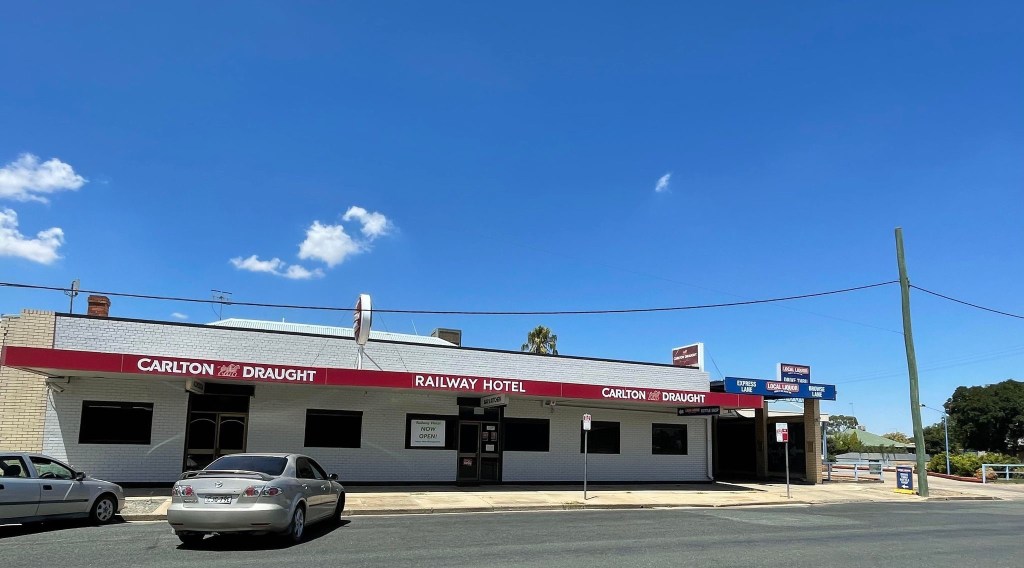
The Carriers’ Rest was located where the Railway Hotel currently stands.
Mr. J. Kelly as auctioneer leased the hotel to Mr E. J. Rogers in March 1903.
The hotel was described in 1911 as having been made substantially of wood with 13 rooms, cellar, wash house, stabling and six loose boxes.
Ads in 1910 advised that George Morris was the proprietor and the hotel had good stabling and loose boxes, George moved on to the Court House Hotel in Bendigo in 1913.
In 1913, Mr G. Pollard sold his interest in the Hotel to Frank Trist.
In 1921, The Carriers’ Rest was one of several Hotels in the area that was under threat of de-licensing.
It was felt that Deniliquin had too many Hotels and some must close with the Kyneton Club Hotel and the Carriers’ Rest fighting for survival in Napier Street.
It was decided to close the Carriers’ Rest Hotel in 1922 with the Kyneton Club Hotel staying open for another decade.
An auction was held to sell off items on June the 27th and June the 29th 1922, Frank Trist was awarded £1650 in compensation.
The Carriers’ Rest was de-licensed and closed on June 30, 1922, and Frank Trist died in 1936.
Frank Trist transferred the property to J. W. Taylor in August 1922.
After the Carriers’ Rest was closed, it was reopened as the Railway Hotel as a fire destroyed the Railway Refreshment Rooms next to the Railway station in 1924.
In November 1924, tenders were invited for general renovations to the building known as the Carrier’s Rest Hotel and was signed C. Carpenter – Railway Hotel.
Mr. C Carpenter in March 1927 gave the lease of the Hotel to Mr. Alex McPhee.
After McPhee it appears Norman D. Tait (who once served as the town’s nuisance inspector) was the licensee/owner of the Hotel.
A man in 1929 was jailed for six months after going to the hotel and giving Norman Tait a stolen cheque.
The license of the hotel was transferred from Norman Tait to Fredrick George Owens in November 1929.
In 1931, The license of the Hotel was transferred from Frederick George Owens to G.D Munro on the 12th of February 1931.
In November 1932, the buildings that made up the Railway Hotel were put up for auction for removal so a new Railway Hotel could be built.
The Railway Hotel was re-opened on April 16, 1933, after attempts in 1932 to temporarily operate at the former Kyneton Club Hotel site failed.
Reg C Carpenter came aboard on the 2nd of February 1935 and there was no change until William Hart came along on January 4, 1941.
Doris Hart managed the Hotel after William Hart was granted a leave of absence.
There were reports that the Hotel was going to be called the Riverina Hotel as the hotel was listed under that name in the phone book in 1941.
Reg C. Carpenter taken over the license from William Hart on December 18, 1945, and Illidge James Carpenter took over on the 8th of June 1949.
Former licensee G. D. Munro died at his home in Deniliquin on May 4, 1954, he was 79 years old, and he had also run the Central Hotel.
Dorothy Emily White taken over as licensee on the 21st of September 1955.
The hotel was raided on July 5, 1959, and twenty-two people were found to be drinking during prohibited hours, all but one person was a local, and the licensee was also fined.
Ronald Arthur Casey taken over on January 18th, 1967, the Hotel changed hands twice in 1973 with Mr Monighetti in June 1973 and Charles Henry Thompson coming in on the 16th of October 1973.
John Bortoli came in on the 20th of December 1977.
The hotel was auctioned off on December 1, 1981.
Rooney Coates was the licensee of the hotel for seven years until selling up in 1997.
The Railway had a resurgence in 2022 with ads playing on 2QN and live music was a fixture once again at the hotel.
Carriers’ Arms Hotel (Cowley/Hancock)
This is one of the most confusing hotel histories in the local area as there have been multiple Carriers’ Arms Hotel’s running.
This particular one is the Carriers’ Arms Hotel which may have been located around 6 miles from Deniliquin.
It is said in December 1875 papers that a Mr Holloway transferred his license to run an establishment from the Carriers’ Arms to Pretty Pine.
Nothing has been found in regard to 1876.
The Hotel name appeared again in 1877 with Mr. Cowley named as running it in 1877, Mr. Cowley ran the Hotel until his death in 1880.
In 1877, A meeting was held at the Hotel to establish a branch of the Hibernian-Australia Catholic Benefit Society.
Mrs. Cowley was fatally burned in 1877 after stepping on a Lucifer match in Cressy Street, her footwear set off the match and she caught fire due to high winds; the fire was put out by Mr. Cowley and Mr. Watson, but she died from her injuries.
In 1879, A woman was reported to have been found bloodied near the Hotel.
After Mr. Cowley’s death in 1880, the license was then held by Marion Cowley.
Five people were charged with stealing from the hotel in March 1880, three of the defendants were found guilty whilst the other two were acquitted.
John Hancock was listed as running the Hotel in 1883 and his name and the Hotel was last seen in 1885 records.
White Lion Hotel (aka White Lion Inn)
Known informally as The Zoo, there have been at least two buildings as the White Lion at the one location.
In 1874, William Simpson who was landlord of the Hotel died, he was regarded by many to be an honest and industrious man.
The license of the hotel was transferred from the late William Simpson to Margaret Simpson in June 1874.
Thomas Hill applied for permission to have dancing and music at the hotel on July 14, 1882, the application was not entertained.
The Government Gazette of September 1881 listed Thomas Hill as running the hotel.
Margaret Simpson applied for and was granted the right to have the license of the hotel transferred from Thomas Hill to herself on October 30, 1882.
The White Lion was robbed in 1884 after a man drew out two people by claiming their horses were being strangled and while they investigated, their items were stolen.
Margaret Simpson transferred the license of the hotel to William Barr on April 11, 1885.
William Barr transferred the license of the hotel to John Wood on January 19, 1886.
In 1889, an inquest was held at the hotel after a body was recovered from the river.
James Austin was given the license to the hotel on February 27, 1891.
Edward Reynolds was listed as the Publican in 1893, the address put down was End Street but this isn’t odd as End Street used to run for a long way.
Edward Reynolds transferred the license of the hotel to Charles McKees on July 2, 1895.
On October 8, 1896, The White Lion was put up for sale at the Royal Hotel.
Mr E. Thomas in 1905 taken over the license of the hotel from Mr S. H. Norwood who taken a hotel near Bendigo.
A man was charged with attempting to steal items from a hotel room in August 1906, but the case was dismissed.
The Hotel survived the de-licensing investigations of 1921 despite the seven room, brick wall and iron roofed building being considered to be in a very bad state of repair.
John Thomas Bouchier ran the hotel for many years before retiring in the early 1920’s, he died in 1927 at the age of at the sixty-three.
Walter Bott brought the White Lion lease from Mr. Murgha Crowe in August 1928.
Reuben Green taken over the license of the hotel from G. Lawrence.
In 1932, White Lion licensee Reuben Green died at the of 48 and Ethel Levinia Green had taken over the license.
In May that year the lease, license, goodwill as well as furniture and effects of the Hotel were put up for auction with the lease expiring on January 2, 1934.
The hotel was written about in the June 10, 1947, edition of “The Land“, included was a photograph of the hotel.
Gwendoline Ferguson came in on December 14, 1957.
John Stanhope Taylor took over the Hotel on January 22, 1958, and the current White Lion opened that same year, it was reported in 1958 that Johnny Taylor found coins in the hotel walls.
The original hotel bar closed on December 19, 1958, a beer garden was built on the site of the old bar, and the current White Lion Hotel was built further back on the same site.
Former licensee Walter Leonard Bott died on August 21st, 1958, at the age of 70.
John Stanhope Taylor was fined in January 1961 after a number of men were found drinking at the hotel on Sunday October 30, 1960.
Peter Strongman was the publican of the hotel during the 1990’s.
In current times, ‘The Zoo’ is well known for their Raffles and Karaoke Night, patrons have been known to sing ‘The Horses’ up until 2018.

The Black Swan Inn/Hotel stood on the site of the Federal Hotel on the corner of Cressy and Napier Street.
An April 1882 account mentions the license being transferred from George McLeod to Mrs. Smith.
Mary J. Smith was listed as running the hotel in 1882 followed by Francis D. Bassett in 1883.
Francis Bassett transferred the license to Mr. Marshall on April 8, 1884.
C. F Judd was given the license to the hotel on November 26, 1885.
Frederick Marshall died in February 1886 after living in the Deniliquin district for thirty-five years.
C. F. Judd transferred the licence of the hotel to Thomas Edward Rose on November 8, 1886.
Thomas Edward Rose sold items from the hotel the day before he transferred the license to Bridget Marshall on January 28th, 1887.
The Black Swan was destroyed in an 1896 fire that also destroyed several nearby businesses.
The fire made news in several colonies (states were referred to as colonies pre-1901) and was infamous because of a Firefighters strike was taking place at the time of the fire and the fire brigade refused to stop the fire that could have saved the Black Swan and other local businesses.
If the fire was prevented there is little to no doubt that Deniliquin’s hotel scene would have drastically been altered as the Federal Hotel would not have been built when it was if not at all.
Former Licensee, Mr. Thomas Edward Rose died in hospital in 1915.
Edward River Hotel (still standing, North Deniliquin)

Nicknamed the Buncha, this Hotel has withstood several floods (1889, 1917, 1931 and 1956) and damage from an 1890 storm.
In 1876, Henry Willmore (written in a newspaper as Willmoor and Wilmore) was granted a license for the Hotel, his was one of only two town licenses granted out of seven applications, Mr. Wilmore was previously rejected in September 1876.
The Hotel had twenty rooms, 25 stable stalls, 3 shops and seven acres of land when put up for sale by Mr. Wilmore in 1882.
In March 1882, The Hotel went from Mr. Willmore to Mr. J. O’Reilly and Mr. Willmore was said to have been out to “seek fresh fields and pastures new”.
J. O’Reilly transferred the license to Mary J. Smith on March 21, 1883.
In 1900, James McKenzie was listed as the publican/licence and in 1906 he was fined for having two patrons on the premises on a Sunday.
Advertisements appeared in 1903 editions of the newspaper that the hotel was ‘To Let’ and interested parties had to apply to Thomas Hetherington.
L. Maher ran ads advising he had leased the hotel; Carlton Ale was on draught and the hotel had splendid accommodation for boarders.
The 1917 flood affected the hotel with the June 22nd edition of The Independent reporting that the flooding was up to the veranda of the hotel.
In 1921, the licensee of the Hotel was Mrs. L. Donovan, the hotel was described at the time to have 12 bedrooms (4 for family), three parlors, dining room, billiard room, kitchen, a 12-stall stable and loose boxes.
The hotel was chosen to remain in business while the nearby Victoria Hotel was de-licensed.
The Executrices of Thomas Hetherington put the Edward River Hotel on sale on June 13, 1922.
A branch of the ALP was formed at the hotel in July 1925 with Arthur Sullivan appointed President and John Donovan secretary.
A man was fatally injured in a fight outside the hotel in 1928 and hitting his head on a metal roadway.
In 1931, flooding caused the cellar of the hotel to flood, the flooding was caused by a ventilator that was not blocked off.
In 1934, two bicycles were stolen from the premises.
In 1936, the lease of the hotel was handed over by Mrs. L. J. Donovan to Mr. R. Donovan.
Three men in 1936 were arrested and then plead guilty to being on the licensed premises during prohibited hours.
In 1938, Mr William Hawkshaw brought the lease of the Hotel from Mr. Roy Donovan.
In 1937, three bags of Chaff were stolen from a shed and in 1939 there was a theft of Cigarettes and Liquor.
In 1939, Mr Hawkshaw ‘disposed of his business’ due to ill health and the business was taken up by Mr Lawrence from Melbourne, Mr Hawkshaw died in Deniliquin on January 19, 1940.
In 1944, Percy Lynch was mentioned as the licensee when he was fined for failing to enter than names of the lodgers in the register.
A baby car was stolen from the front of the hotel in September 1945, it was believed to been driven to Mathoura before being left outside the Air Station in Deniliquin.
A man in 1946 was charged for being on the premises on prohibited hours but was found not guilty.
The license of the hotel was transferred from Patrick O’Hanlon to Wentworth Murray Ivers on July 22, 1947.

In 1949, the license of the Hotel was transferred to Molly Anne D’Argeaval and in December of that same year £349 and the cash box it was contained in was stolen from the hotel.
It was reported in 1959 that a ‘canoe tree’ existed 70 yards from the bend in Davidson Street which placed it near the hotel, a ‘canoe tree’ was when aboriginals would carve out a canoe from trees, that particular tree was said to have been used in 1906 when an aboriginal used it so he could retrieve items from his isolated from flooding camp.
These days the hotel is informally known as ‘The Buncha’ and has been a popular place to have a drink and listen to some live music.
Faugh-a-Ballagh –> Sportsman’s Arms Hotel –> Sportsman’s Arms Hotel/Motel –> Sportmans Arms Hotel (still operational)
Opened in 1857, It changed its name soon after to Sportsman’s Arms.
In 1864, the hotel was put for auction and despite it being the Sportsman’s it was still better known as Faugh-a-Ballagh, the sale included a paddock the size of 25 acres.
William Herriot transferred the license of the hotel to Richard Manly on June 11, 1867.
Thomas Stalley transferred the license of the hotel to William Herriot on Tuesday February 15, 1870.
Robert Pyke taken the license of the hotel in May 1870.
Robert Pyke transferred the license of the hotel to William Herriot Jnr on June 20 1872.
In 1887, William Heriot left the Sportsman’s Arms after a reported 15 years (may actually be 17 years) to go to Melbourne but returned shortly after to run the Globe Hotel.
Plans for the hotel to have new premises were approved in January 1904 with demolition of the old premises occurring in February and the new premises were completed in May that year with the opening being that same month.
In 1915, William Morran was licensee and was fined 3 pounds and 2s for breaching the Liquor Act, William Morran died in Elwood in 1928.
In 1924, the proprietor of was H. W. Oxenham.
Walter Bott sold in March 1928 the goodwill and lease of the hotel to Jack Charleston.

A. McPhee took over the Hotel on the 5th of June 1929 and Les Bott took over on the 17th of April 1930.
Les Bott handed over the license to Mr. J. Danckert in November 1930.
In 1947, hotel owner Wallace Stillard’s plane disappeared, the aircraft and his remains were found in 1948.
The hotel license was transferred from Norman Arnold Imhoff to Anne Eileen Imhoff on June 17, 1947.
Dave Prior taken over the license of the hotel in September 1951 from the Imhoff’s.
The freehold of the hotel and 15 acres of land were put up for auction following the death of Mrs. Morran.
The auction held in March 1953 failed to meet reserve with negotiations being held with Geoffrey Hetherington, the highest bidder in the auction.
Reginald Wigg transferred the license of the hotel to Geoffery Hetherington in January 1958.
Two Gold Sovereigns were discovered in February 1958 during the removal of walls in the hotel; it was also reported that the hotel was once called the ‘Foggabolla’ and the nearby bridge was called the Foggabulla.
‘Foggabolla’ has been the name of several horses and sounds a lot like the name ‘Faugh-a-Ballagh’.
John Stanhope Taylor took over the Hotel on January 22, 1958, and the current White Lion opened that same year, it was reported in 1958 that Johnny Taylor found coins in the hotel walls.
Walter Leonard Bott died on August 21st, 1958, at the age of 70.
The hotel played a part in North School’s (Mark III) history as two meetings were held in the early 1960’s to find out what was happening with the school being constructed across the road (it eventually opened in 1963).
The Hotel changed its name from Sportman’s Arms to Sportman’s Hotel/Motel on the 16th of December 1968.
Geoffrey Hetherington and Maurice Hetherington ran the hotel into the 70’s with Maurice’s time starting on the 18th of July 1978.
The Cally’s ran the hotel for two decades before divesting the hotel to a private investor who handed it to another operator before the Cally’s were returned before the private investor decided to sell in 2020.
The site of the hotel is 2,816 square meters and contains a sports bar, a lounge bar, a gaming room complete with four Poker Machine Entitlements (PME) allowing four machines in the hotel, there is the open-plan bistro and commercial kitchen, a bottle shop, a car park and finally the ten motel rooms at the back.
It also has a 50-kilowatt solar system which is equal to ten 5kw home systems.

Trivia: Faugh-a-Ballagh was also the name of several horses.
Exchange Hotel (South Deniliquin)

The Exchange Hotel has been a fixture on End Street for many, many years.
Bricks were thrown at the windows of the Exchange Hotel in July 1866.
William Perry transferred the license of the Exchange Hotel to Crawford Ross in August 1867, a music license for Monday and Saturday nights was granted to Mr. Ross on November 25, 1867.
The license was transferred from Crawford Ross to Richard DeCuster in 1868.
An attempted transfer of license from Richard DeCuster to John Nugent in June 1870 was refused.
J.E Winterbottom was granted a license for the hotel on December 10, 1877.
J. E Winterbottom transferred the license of the hotel to Hans Sorrenson on May 14, 1878.
The hotel faced tragedy in April 1878 with the death of Lily Newton who had died by suicide at the hotel.
Hans Sorrenson transferred the license of the hotel to Claus Pump in July 1880.
Caroline Pump drowned in the Edward River in July 1880, a short time after her husband had taken over the Exchange Hotel.
Henry Rogers applied for and was granted the license to the hotel on May 27, 1882.
Alfred Lambert was found at the rear of the premises on October 5, 1882 with his ‘skull smashed in’, he was taken to hospital but died hours later, the verdict by in an inquiry was ‘wilful murder’ but nobody was found responsible.
The license of the hotel was transferred from Henry Rogers to William Austin in December 1882.
Mr H. Hawkins brought the hotel for £425 in late August 1887.
A destructive fire at the hotel on April 27, 1888, could have brought tragedy to town had it not been a narrow escape from the fire by Mrs. Austin and children.
Mr. Austin on April 30, 1888 was granted permission to carry on business in temporary premises for two months.
William Austin transferred the license of the hotel to Felix Galli on January 6, 1894, and ended a thirteen-year stint at the hotel.
Felix Galli transferred the license of the hotel to D. McDonald on July 24, 1894.
D. McDonald transferred the license of the hotel to John Fergusson on September 4, 1895.
1901 Mr John Kelly as auctioneer leased the hotel to Harry Trist for a term of 5 years as well as selling the furniture and effects, goodwill and stock in trade to Mr Trist.

Former proprietor John Ferguson died in April 1901 at the age of sixty-five, Mr. Ferguson also ran the Railway Hotel.
In 1902, Harry Trist was fined for having a cask that did not have a duty stamp on it, the manager of the local brewery was fined for not putting the stamp on the cask.
A Bailiff acting on behalf of the Riverine Brewery Co. entered the premises in March 1903, the man was seen leaving as quickly as he entered and this was followed up by twelve men who attempted to enter the hotel, the licensee locked the gates and doors of the premises, and the men could not enter the hotel.
The hotel was leased to Frank Trist in March 1903 shortly after the incident with the Bailiff and the following twelve men.
In 1908, Frank Trist was accidentally mailed 20 tins of Opium that was intended for another Deniliquin location.
Commonwealth Football Club held their AGM (Annual General Meeting) at the hotel in late April of that year.
In 1911, The Independent had ads that Charles Langshaw was the licensee of the Hotel, assuming the ads started in 1911, they ran until 1914.
Mrs Langshaw in December 1911 found a man hiding under her bed after noticing the furniture in her room was disarranged, the man escaped with £14 in notes, gold and silver.
In 1920, E.T Matthews oversaw the sale of the Exchange, and it was brought by Margaret Langshaw.
William Jones was fined for having a person on his premises on Christmas Day 1923.
In 1927, Margaret Langshaw put the Exchange up for public auction on Thursday March 3, 1927.
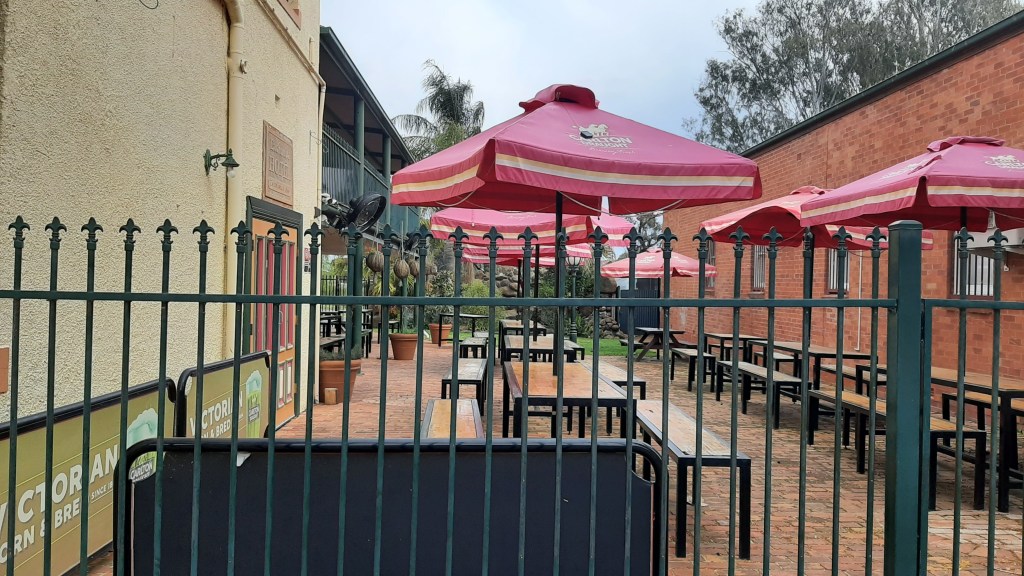
The license for the Exchange Hotel was transferred to the Wakool Hotel in October 1928 and an auction of furniture and other household effects was held on October 30 and 31.
An auction was held on November 14, 1928, and described the place as Lot 2, Section 17 and described the Exchange as containing 22 rooms.
In 1929, The Hotel was reported to have been rebuilt and reopened under the guidance of Mr. Jack Grieve.
The hotel was described to have a total of twelve single and double bedrooms and were apart from the staff accommodation.
Jack Grieve transferred the license of the hotel to George Henry Guy in June 1930.
It was reported in July 1931 that water from the lagoon behind the hotel overflowed into the yard of the hotel.
Additions were made to the hotel in 1933 after a successful application was put in by Mr. P.F Phillips and the additions were described to be ‘a portion of an hotel, an old wooden structure which had been ordered to be abolished.
In 1936, former licensee Frank Trist died at the age of seventy-eight and it was that the Exchange ‘has been delicensed for some years’ though as we know the Exchange was very much still in business.
George Guy transferred the license of the Hotel to William Thomas Hart in June 1937.
William T. Hart transferred the license of the hotel to Walter Matuschka on June 2, 1938.
The license of the Hotel was transferred from Walter Matuschka to Mrs. Rose Gardner on March 9, 1939, the transfer was originally set for Fredrick John Kay, but it was withdrawn, Mr. Kay owned the freehold.
An application was made to connect the hotel sewerage system to the town system instead of a septic tank in use at the time, the application was granted with a time set for two months.
Mr. Langshaw died on November 30, 1939, at the age of seventy-six.
Mrs. Rose Gardner transferred the license of the hotel to Mrs. Mary Winifred Hammond on September 5, 1940.
Mrs. Langshaw died on July 13, 1946, at the age of eighty, it was reported that after the Exchange was sold, she retired to live privately.
Mary Winifred Hammond transferred the license to John Joesph O’Shea on June 17, 1947.
John Joesph O’Shea died in Deniliquin Hospital on September 8, 1953, after suffering a seizure at the hotel.
Former licensee George Guy died on April 14, 1961, in Deniliquin Hospital, he was 88 years old.
The Deniliquin RSL Club brought the hotel from Carlton United Breweries in June 1962.
The hotel’s cellar has attracted interest as a cellar wall has what appears to be a bricked-up entrance point, if it is then where did it lead to and what was its purpose?
Royal Hotel –> Coach House Motor Inn –> Royal Colonial Hotel Motel –> Coach House
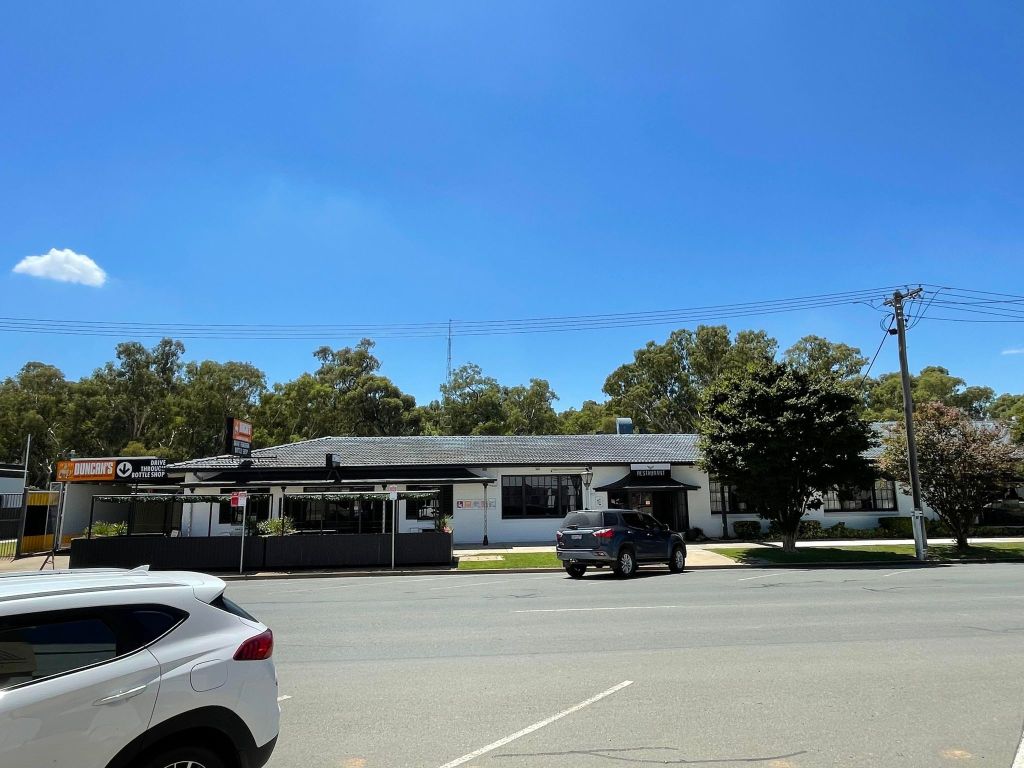
The Royal Hotel had at least three fires between 1858 and 1861 with the third fire resulting in a death when its stables were set alight.
The dimensions of the hotel expansion in 1861 were given as 71 feet long by 32 feet wide and when combined with the pre-1861 building gave a frontage of 110 feet.
The Royal Hotel had a Soda Water Manufactory which caught fire in June 1866, but the fire was put out in time for the hotel to avoid destruction.
Ginger Brandy, Ginger Wine, Soda Water, Sarsaparilla, Raspberry Syrup, Peppermint and Ginger Beer were among the choices offered at the Manufactory; this business was sold to George Elliott in 1867.
William Bignell applied for and was granted a license for the hotel on April 19, 1870.
In 1877, you could buy a pint of Ale for the price of 6d.
The license was reported to have lapsed by February 1878 with the hotel being called the Deniliquin Club-house.
Samuel Willis died at the hotel in July 1878, he was once the caretaker of the Mechanics Institute that was located in town.
A. L. Glasson obtained the license on June 7, 1884, and transferred it to J. W. Brace on May 30, 1885.
J.W. Brace transferred the license of the hotel to Charles B. Spearing on October 31, 1885.
In 1886, Henry Cheswick brought the hotel for £4100 at an auction in Melbourne, it was until that point owned by a limited liability company.
Charles B. Spearing transferred the license of the hotel to James Halliday Wilson on April 5, 1887.
James Halliday Wilson transferred the license of the hotel to Isabella Young on February 27, 1891.
A Judge was robbed at the Hotel in 1904 with money and an overcoat stolen.
A man was charged and fined for being on the premises during prohibited hours in April 1907.
Between 1911 and 1914 there was fighting over the ‘Royal Hotel Gardens’ as there was an attempt to enclose a section of Junction Street that had adjoined the hotel.
Mr. E. G. Sweet brought the freehold, building, furniture and goodwill of the Royal for £5000 in 1914.
In 1925, tenders were wanted for repairs, additions and alterations to the Hotel.
Mrs. Oxenham was injured in 1927 when she fell down the cellar stairs of the Hotel.
Thieves visited the hotel on Good Friday in 1927 and stole ten shillings and a five-pound note from two bedrooms.
H. W. Oxenham transferred the license of the hotel to Elizabeth Clarke in March 1929.

The Hotel made news in the 1930’s when a Cow decided to pay a visit, the cow made its way upstairs and into a bedroom before leaving the premises.
In 1936 a man was charged with stealing money from the bar counter.
In 1937 the license of the hotel was transferred from Mrs. L. Tuckwell to Mrs. E Clarke.
The license was transferred from A. L. C. Jones to Bernard James Rush on December 22, 1942.
In 1946, the hotel license was reported in The Independent to have transferred from S. T. Willoughby to Thomas Gregory Hooper.
In 1948 the proprietor of the Hotel was Mr. T. G. Hooper.
Mary Isobel Newton applied for and was granted a transfer of the hotel license from Donald Fredrick Washington to herself.
The licensing court in September 1954 ordered owner Mr. Gleeson to improve the hotel, this included repairing the roof, renew the fire escape, provide keys for all bedroom doors and more hot water storage.
The hotel was robbed in August 1956 with thirty pounds of cash and a similar amount in cheques stolen, the thieves got in through the street entrance to the cellar.
The freehold of the hotel was sold in November 1956 to Mr. and Mrs. Wise.
The license of the hotel was transferred from Mary Isobel Newton to Alfred Wise on January 10, 1957.
It was announced in January 1957 that 20 feet of Junction Street was enclosed in the hotel yard, it was believed that every owner from Mr. Sweet in 1914 onwards thought that it was part of the hotel property.
Cornelius Aldworth Hurley took over on the 18th of February 1958 and continued on until handing over to Allan Michael Ryan on the 19th of December 1960.
Mr. and Mrs. Ryan were manager and manageress of Young and Jackson’s Hotel in Melbourne from 1937 to 1956.
Travelana Holdings Ltd. made a takeover offer for Hotel Deniliquin Ltd. in June 1961, directors accepted the offer and recommended the offer to shareholders, Travelana plans involved the demolition of the hotel and replace it with a forty-room hotel-motel.
It was announced in March 1962 that the hotel would be demolished in May that year, some bricks were to be retained in the frontage of the new construction at the site.
The Royal Hotel was closed on May 26, 1962, some locals couldn’t wait for the upcoming auction and helped themselves to spirits and wines with 60 pounds worth of drink taken, two tables and eight bar stools were also reported as stolen.
Demolition of the hotel started the following Monday with the furnishings auctioned off on June 5, 1962, theft even occurred during this auction with several winners of items discovering that their items had been stolen.
A small fire broke out in the basement of the then partially demolished hotel in June 1962.


The Coach House Motor Inn was soon built on the site, and it was officially opened on December 6, 1962, since then it has traded as various names but has lived a long life like the hotel before it.
Edward Maxwell Riley taken over the hotel on the 16th of October 1962 and handed over to William Arthur Freebody on the 23rd of February 1966.
In 1966, Toohey’s taken over Coach House Motor Inn Ltd and Hotel Deniliquin Ltd, the two companies owned hotels in five locations.
The hotel was part of the Zebra Group in 1975 and the phone number was 5881 1011 and there was 32 units to choose from.
The cellar of the hotel is rumoured to have a now cut off access point to the Exchange Hotel across the street.
On Wednesday September 27, 2000, the 1,915-acre property “Yarree” was auctioned at the Hotel, this is one example of the many auctions that were conducted at the location.
In August 2019, it was feared that the Coach House would have to close due to financial issues but fortunately for the town, this issue was solved, and business resumed by the week of August 18.
The Shamrock Hotel
Was located in Victoria Street where it still exists as a house.
A meeting of electors was held at the hotel in February 1869.
The Shamrock was flooded in the 1870 floods.
In 1877, a man’s body was moved to the hotel after it was found following a Thunderstorm outside of town.
The hotel was run by Henry Lee up to his death in September 1878.
From 1879 to 1882, The Hotel was run by Nicholas Butterly.
John Allen was granted a license for the Shamrock Hotel on November 1, 1883.
An inquest into the death of a man who drowned in a puddle was held at the hotel in January 1886.
The Shamrock Hotel was auctioned off on September 16th, 1886.
A wing of bedrooms at the back of the old hotel were flattened in a storm that tore through the town in December 1890.
The Queensland Hotel (North Deniliquin c1878)
The Queensland Hotel was mentioned in February 1878 being owned by Mr Robert Middlemiss and it would be the 29th Hotel in Deniliquin at the time with the 30th being The Continental.
Robert Middlemiss built both the Queensland Hotel and the Bendigo Hotel.
In August 1878 the Queensland Hotel was listed as being in Albert Street, Deniliquin and stabling at the hotel was free, a 1942 account by Mrs. Hannah Mitchell gave the location as opposite the Sportsman’s Arms.
In December 1878, a publican’s license was granted to G. McLeod.
The hotel was described as having eight rooms, kitchen, stables and the best well of water in Deniliquin.
Applications for publican’s licenses by Mary Ann Egan and Elizabeth Ellen Coyle and a license transfer from George McLeod were withdrawn in May 1879.
The hotel was being sold at the Royal Hotel on Tuesday July 22, 1879; it was passed in at £150.
The hotel was for lease or cheap sale in 1883.
The Queensland Hotel was mentioned in 1890 as land was sold near the “old Queensland Hotel”.
Robert Middlemiss died in Deniliquin on the 25th of May 1911 at the age of seventy-seven, he was a butcher and a baker between 1865 and 1870.
Court House Hotel
The Court House Hotel was a popular hotel that existed into the late 1960’s, the site of the Hotel is next to where Target is today.
William Kiely died while the hotel and the license was transferred to Ann Kiely in 1867 before Robert McCullough was listed as running the establishment the next year.
In 1869, Decimus Lamb taken over before Robert Harvey Pyke was listed in 1870 meaning that nobody held it for less than two years.
William Macdonald was listed in 1871 and began what was to become a long reign as the publican of the Hotel.
The body of John Taylor was brought to the hotel after his death at the Boxing Day races event in 1876, the inquest into his death was held at the hotel the next day.
In 1877, the Hotel’s clothesline was stripped of its linen during a series of property damage to Deniliquin’s hotels.
William Macdonald died in 1889 at the age of sixty-nine.
Eliza Macdonald taken over the license in 1890 and next to be listed was Elizabeth Brophy in 1892 and stayed until Henry J Poynter was listed in the 1896 edition and in 1898 edition James Lawson was listed as the Publican.
Henry Field was next listed when the Government Gazette of 1900 was released and Samuel James Outram was listed as running the Court House in 1901 and was last listed in 1909.
In 1910 Harry Trist was listed as running the hotel followed by Frank Trist in 1911 and Matthew Carew was listed in 1912 and John H Donovan taken over in December 1912.
Matthew Carew departed Deniliquin with his wife and family in December 1912 and headed to Melbourne.
Abbotsford Ale and Victoria Bitter were on offer at the Court House in 1914 with both of them guaranteed to be cold.
The owner around the time of Matthew Carew’s reign as licensee was Mrs. McLeod.
John Bellett was listed in 1914 and was the licensee until March 3, 1920, the license was transferred to Theresa Maher on that date.
In the mid 1920’s, A garage run by Doug Everitt opened at the rear of the Hotel and faced George Street.

The side of the hotel has confused those who looked at postcards and could see the side of the hotel facing down Cressy Street, as it looks like a giant house as seen in the above late 1930’s photograph.
Former licensee John Bellett died in Echuca during June 1933 at the age of sixty-eight.
Arthur Barnes was the licensee of the hotel for some years, and he died on February 2, 1938, at the age of fifty-one in Deniliquin.
Arthur Barnes was succeeded by Theresa Barnes on the 23rd of May 1938, and she was replaced by George F. K. Hall on the 9th of March 1939.
The license of the hotel was transferred from George F. K. Hall to James Bertram Jones on March 21, 1944
John Hayes was charged in 1946 for selling a bottle of Gibley’s Gin for more than the fixed price set by the National Prices Security (Prices) Regulations, the £1 bottle cost him £20 in fines plus costs.
An application to make alterations and improvements to the hotel was made in September 1946.
An amount between £600 and £700 (one report £760) said it was stolen from a safe at the hotel on January 9, 1949, the thieves stole the safe keys from the room of hotel licensee Max Henry while he slept, and they left the premises at around 3am.
A meeting of creditors was held at Town Hall on March 20th, 1964.
The Court House Hotel stood until 1967 when it was demolished, its demolition forever changed the landscape of Cressy Street.
Court House Hotel Pty Ltd was de-registered on the 20th of March 1967.
Camperdown Hotel
The license for the Camperdown Hotel was granted on February 17, 1877, to Mary Kearney.
The hotel was located in Harrison Street, which was then part of Duncan Street, The Camperdown is known to be seen in at least one photograph.
The Camperdown was first listed in the March 27, 1877, edition of the Government Gazette with a Publicans license for the hotel given to Mary Kearney.
In September 1877, a body was brought to the Camperdown and was identified by a worker of the Hotel as that of her husband who had disappeared a month earlier.
In 1878, a “To Let” notice was published in the Bendigo Advertiser and other newspapers with the ad stating that the hotel had twelve rooms.
It was reported in October 1878 that Mary Kearney transferred the license to Alfred Watson.
Alfred Watson’s license was cancelled on January 31, 1879, after failing to appear in court when summoned by police over abandoning his house licensed (hotel).
An auction was held on the premises of “late Camperdown Hotel” on February 11, 1880.
The building was mentioned in the December 1, 1928, edition of The Riverina Recorder said ‘The old Camperdown Hotel was now owned by the school’ – the school being St Michaels.
The building was demolished and reconstructed in 1939 to become the St. Michael’s Club.
The Live & Let Live –> Brewers’ Arms Inn
The Live & Let Live is reportedly the 13th Hotel to have been built in Deniliquin throughout its history, its location was originally End Street which was later on partly turned into Maher Street.
Later on, the Hotel changed its name to the Brewers’ Arms Inn and continued trading.
Owners of the Brewers’ Arms included John Dickson and H.A Foster with Fredrick Fairchild being landlord in 1879 followed by George McLeod the same year.
William Johnson died at the hotel in May 1867.
In 1870, a man named Cother disappeared after stopping in at the Brewers Arms Inn, he was later found to have accidentally drowned in the southern lagoon.
It was a busy year in 1879 as the Brewer’s Arms made news when Fredrick Fairchild was fined £10 for allowing Prostitutes to assemble in his house.
Police Constable Robert Algie was charged with stealing a watch from a patron and George McLeod was fined £2 for selling after hours and a further £3 in July 1879 for allowing dice to be used in his house.
In 1887, An inquest was held to determine the cause of death of Thomas Warner who accidentally drowned in the Edward River.
The Brewer’s Arms later become a residential house and it still stands today as one of the few hotels that were transformed into a house and is still standing today.
Highlander Inn –> Commercial Hotel –> Australian Club Hotel –> Tattersall’s (1893)
The first found mention of the Highlander was in 1857 when a man named Henry Allen was charged with Larceny.
Listed for a time as the ‘Highlander and Irons’ Family Hotel’.
James Irons ran the hotel until 1865 and John Joseph Roberts started running the hotel later that year.
John A. Roat applied for a publican’s license to operate the hotel on April 19, 1870, the license was granted.
The license for the hotel was transferred to John O. Atkinson on November 26, 1872
John O. Atkinson was granted a music licence for Thursday and Friday nights in April 1874 and was granted a billiard license in June 1874.
John O. Atkinson transferred the license of the hotel to John F. Thompson in September 1876.
The license of the hotel was transferred from John T. Thompson to Robert Johnston on October 14, 1879.
Robert Johnston ran the Hotel from October 1879 until July 1882 when he returned to Echuca and the license was transferred to Mary Kearney on July 3, 1882.
Mary Kearney and Annie Elliot wounded brewer George Elliott with a carving knife in February 1883, Mary was arrested at the Commercial Hotel.
The Commercial Hotel was destroyed by fire on February 13, 1884, with Mary Kearney, Richard Marum, Mary Ann Marum and the Marum’s baby Catherine dying in the fire.
Annie Elliott, who was also at the hotel, escaped the fires by jumping through an open window and landing twenty feet below suffering a concussion.
The Commercial was considered by the Riverine Herald to be ‘one of the largest hotels in Deniliquin and considerably more commodious than any hotel in Echuca’.
John Adams on February 26 applied for the hotel’s Billiards license, which was approved, he also applied for the license of the hotel to be removed from the Commerical and given to the Bendigo Hotel, this was also approved.
Advertisements in March 1884 had the hotel to be either “For Sale or To Let on repairing lease. on easy terms”, it was also considered to be a bargain but made no mention that people died there.
In August 1884, Charles J. O’Brien was running the Hotel after the death of Mary Kearney.
Charles J. O’Brien had insolvency issues in September 1884
In December 1884, J.B Watson donated the Hotel to Deniliquin Hospital on the condition the property is not to be sold or alienated.
Frank Sparrow announced in September 1885 that he had opened the Australian Club Hotel at the premises formerly known as the Commerical.
An auction was conducted at the hotel in October 1886 to sell Mr. James Bulger’s land in Tuppal.
Sheep owners had a meeting at the hotel in June 1888 to consider matters.
A man named Scottie in July 1889 survived after falling into the river at the rear of the hotel, he was rescued by Francis Marshall.
Charles Finney’s license of the hotel was transferred to James Clarke on September 20, 1890.
James Clarke transferred the license of the hotel to Charles R. Reed on February 24, 1891.
Thomas Hirst Dobson’s Publicans license was cancelled on August 2, 1892.
The hotel was re-let by Deniliquin Hospital to James Sinclair in 1892 for the hotel to be converted into a Coffee Palace.
William Heriot purchased the lease of the Deniliquin Coffee Palace and converted it back into a hotel.
In September 1897, applications were invited for the lease of the hotel for a cost of 4 pounds per week.
Chris F. De Fraga was reported to have run the hotel for three years in 1901 and the hotel was a front-page fixture in The Independent.
The Independent reported in July 1901 that Mr De Fraga asked the Deniliquin Hospital for permission to transfer the license to A. Levy and the request was granted.
Robert Buist and Harry Cobden survived a twenty-foot fall in September 1901 when a red gum plank that served as scaffolding gave way and the two plummeted to the ground.
Mr. De Fraga died in May 1902 in Melbourne after suffering from Influenza, he had business interests in both Deniliquin and Prahran at the time of his death and he had died the age of 42.
The following year Mr Levy asked for his five-year lease of the hotel be extended to ten years.
Mr Levy transferred the license of the hotel to Mr R. A. Bazley on September 3, 1906, a few months after having run the hotel for five years.
Mr C. Carpenter was made the new licensee of the hotel in August 1911 although the license was also held by Elliot’s Riverine Brewery Co.
A crisis erupted in 1917 as the Hospital rejected an offer by the Brewery Co. and put the hotel up for tenders to bid for a five-year lease.
Thomas Doolan took over the hotel and in 1920 it was reported that Mr Doolan was granted an extension though there was disagreement about the terms being followed due to the hotel’s state of repair.
In 1921, the license of the Hotel was transferred from Mr Doolan to Mr. Fredrick Jager.
In 1924, Fredrick Jager transferred the license of the Hotel to Louis Thomas Bennett.
In 1930, an application was made and approved to sell the Hotel by the Deniliquin Hospital board to George Admans.
Tattersalls was closed for six weeks in 1931 after the license fee was paid.
In 1932, the license was transferred from Colin Jones to Thomas Mulray.
Two men were fined in March 1933 for being on licensed premises without reasonable excuse at 9pm on February 3 that year.
In 1934, the lease was sold by Thomas Mulray to Mr T. F. Welch.
T.F Welch in January 1936 transferred the lease of the hotel to Jas. Hall.
The hotel freehold was put up for auction on August 19, 1937.
In 1937, the Hotel license was transferred to Mr George Clyde Oddy.
In 1939, the license was transferred from John Moore Murphy to George Henry Myall Sellman.
On September 25, 1940, the license of the Hotel was cancelled, an appeal was lodged but was upheld on the condition that conditions were improved.

George Oddy on January 9, 1941, transferred the license of the hotel to Norman Wheedon.
In 1946, The license was transferred from Thomas Michael Clarke to Harry John Pill.
In 1946, an application for the complete demolition and rebuilding of Tattersall’s was made.
Next on the ownership/licensee list came Rita E. Blencowe and next to her name is a sale date of 23.1.1948.
Charles Harold Richman is next in line on the 20th of July 1949 and Lawrence Alexander Cockayne came aboard on the 21st of June 1950.
George Maxwell Jolly came along on the 17th of January 1951 before Rita Ellen Blencowe was back on the 23rd of July 1952.
A watch and a pair of trousers were stolen from a room in the hotel in December 1961.
A plan for the hotel to be demolished and replaced by a Service Station was approved in December 1961.

The hotel was closed on June 30, 1962, after the Caltex Oil Company purchased the hotel, demolition did not take place until January 1963, two workers were hurt went debris fell on the two men.
The old stables that belonged to the hotel have stayed in place.
Wanderer Inn
Was built in 1847 by Edward John Bloxham and was later owned by John Taylor in North Deniliquin.
‘Saltbush Country’ mentions the Hotel getting its license on July 8, 1847.
Mr. Bloxham made way for Mr. Britton in 1851.
The Wanderer was famously visited by Captain Melville in 1851 and his gang who stayed for several hours before leaving after a failed attempt to pick the pockets of a boarder they had waited on to fall asleep.
Mr. Britton had his license revoked in 1852 and the Wanderer was closed between that time and 1855.
The McKenzie brothers reopened the Inn in 1855, and G. Whipple taken over in 1858.
The Inn was mentioned in now archived newspapers in 1857, 1858, 1859 and 1860 with Mr. Whipple mentioned as running the Inn.
John Robertson taken over by 1861 and he made way as licensee to R. D. Filson in 1866 and then John Taylor.
The Inn hosted a Grand Ball on January 17th, 1867, for the benefit of Mr. J. C. Perrott with dancing commencing at 9pm that night.
Jeremiah Sullivan was the last person to run the Inn when he took over operations in 1867.
The Wanderer Inn burnt down on the evening of July 25th, 1867, and the site of the Inn later became part of Deniliquin North Public School almost a century later.
The inquest into the fire was held at the Sportsman’s Arms Inn in August 1867 with the jury finding that the Inn was deliberately set on fire by William Cadman, the trial was held in 1868.
William Cadman was acquitted of the charge in January 1868.
North Deniliquin Hotel –> National Hotel
First mentioned in September 1866, The National Hotel was described as being a two-storey brick building.
Ads for the hotel in 1868 said “Always on hand – Wines and Spirits of the finest quality selected expressly for private consumption.”
Water entered the cellar of the hotel in 1870 forcing Mr. Robertson and his family to retreat from the building.
It appears that the North Deniliquin Hotel name was last mentioned in the 1878 Government Gazette list and was listed as being run by Thomas Robertson.
The Hotel was ‘To Let’ in May 1879, the hotel furniture was offered for sale over June 3 and June 4, 1879.
The hotel license was transferred from H.C. Hawkins to Annie Robertson in November 1879.
An application to transfer the license from Annie Robertson to John Collins was filed on July. 11, 1881.
There was a Furniture Sale at the hotel on July 14, 1881.
The license of the hotel was transferred from Annie Robertson to John Hassell in August 1881.
The hotel was destroyed by fire in the early hours of February 27th, 1884, it was reported that the hotel was unoccupied for some time and the last property owner was Mr Henry Hawkins.
The fire was reported to have originated in the cellar of the hotel and destroyed the hotel but not the kitchen or dining room.
The hotel was reported as being ‘lately pulled down’ in October. 1886.
Belmore Arms (1875) –> Garibaldi Arms (1879-????) –> Giuleri’s –> Sandhurst
The first record in the archived papers online is from 1868 with Daniel Smith the landlord.
The hotel was mentioned as being on the corner of Victoria Street and Wanderer Street.
Daniel Smith’s license was cancelled on April 19, 1870, having abandoned his house (the hotel).
It was reported in August 1875 that the Belmore Arms ‘after many years untenanted’ was ‘again opened as an Inn’ under Thomas McMillan.
The landlord of the hotel, Charles Llewellen lost his wife to suicide by drowning in 1877.
Daniel Smith was awarded a license to run the hotel in 1877.
A forged cheque was cashed in at the hotel in October 1879, they had also cashed cheques at other establishments in town.
Mr. Giovanni Giuleri applied for and was granted a license for the Belmore Arms Hotel on September 9, 1879.
The Garibaldi Arms was ‘To Let’ in 1881.
Mr Giulieri reportedly died in Echuca in August 1899 whilst seeking medical treatment, he was listed as the owner and licensee of the Sandhurst.
A kitchen fire killed Mrs. Mary Giuleri at the Hotel in October 1901, she died ten days after the accident.
Three locals who were soldiers in the Boer War attended a gathering in their honour at the hotel in June 1902.
Charles Giuleri Giulieri was listed as running the Sandhurst in 1905.
The Independent in 1905 reported the auctioning of the hotel, the hotel came with two and a half acres of adjoining land, all of which was securely fenced, the auction was to take place on March 2, 1905.
Mary Jane Giuleri died at the hotel on May 16, 1905.
In 1906 the same ad that appeared in 1905 appeared in The Independent, this time the auction was set for February 8, 1906.
A man was found at the hotel on June 16th, 1907, during prohibited hours and was fined £1 or seven-days jail.
A man died after falling over and hitting his head outside the hotel in September 1907, the man had reportedly entered the hotel in a drunken state and left after being refused service.
In 1911, John Moroney was listed as running the Sandhurst and the license was transferred to Barham that year to become the Royal Hotel in that that town.
The closure of the Sandhurst brought down the hotel total in the area down from 19 to 18 hotels.
After 1911, there were reports in The Independent reporting a collapsed drain between the old hotel and the North Deniliquin Police Station in 1917 and 1920.
John Moroney died in April 1915 in Melbourne just four years after leaving Deniliquin.
In 1924, the building was again mentioned in a report stating, ‘gutter from the old Sandhurst Hotel along Victoria Street to Hyde Street properly formed with grader’.
Charles Giulieri died in 1935 in Sydney.
The hotel was reportedly located somewhere near or on where DNPS now stands.
Galbraith’s Union Hotel/Inn
Owned and operated by Mr William Galbraith, the hotel was established in 1876, a newspaper report says the hotel was located about 3 miles outside of Deniliquin on Hay Road
Mr. Galbraith’s daughter Jane married Matthew Hole on November 9, 1887; Matthew Hotel was once the license holder of Pyke’s Hotel.
William Galbraith died in 1891; it was reported at the time of his death that he lived in the local area for 25 years and ran the hotel for 10 years though this is incorrect as the hotel was established in 1876.
The hotel was put up for auction in October 1894, but a fire destroyed the eight-room hotel on October 12, 1894.
The hotel fire had also destroyed Aboriginal history as the property held a collection of Aboriginal weapons that were by 1894 considered to be almost unprocurable, it was noted in the October 13, 1894, edition of the Pastoral Times that old tribes was ‘almost extinct’.
Beehive Hotel
Recorded as Bee-Hive and Beehive Hotel and was located in Cressy Street.
Charles Willoughby applied for and was granted a license for the hotel in November 1876 with an “Opening Free Ball” held at the hotel on November 24, 1876.
Charles Willoughby was listed as running the Hotel throughout its existence.
Ads of the hotel had the following;
In this hive we are all alive,
Whisky makes man funny;
If you are dry step in and try
The flavour of my honey
Mr. Willoughby in 1878 believed that the valuation of the premises was excessive, the rate was confirmed.
Mr. Willoughby in 1879 described the hotel as being about halfway between the Bridge Hotel and the White Lion.
Advertisements put the Hotel within three hundred yards of the railway.
Railway Hotel –> Kyneton Club Hotel (KCH unlicensed c1932)
The Railway Hotel was the site of a public meeting in 1873 to form a company to construct a railway from Deniliquin to Moama, the company was called ‘Deniliquin and Moama Railway Company’.
August Mulham applied for a license for the Railway Hotel in November 1876
The Hotel went from W Davis to William Davies, Mr. Davies also brought the Bush Inn in 1882 and the yard of the Bush Inn and the Railway Hotel was turned into the one yard.
W. J. Davies transferred the license of the hotel from himself to John Fergusson on March 3, 1890.
John Fergusson transferred the license of the hotel to W. J. Davies on September 1, 1895.
W. J. Davies transferred the license of the hotel to Edward Reynolds on July 2, 1895.
Mentions of the Railway Hotel stopped in 1901 with John William Webb running the Railway.
It is believed that the Kyneton came into existence in 1901 as the first located record for the Kyneton Club Hotel reported that Michael John Kelly was running the Hotel in 1902 who ran it at least until 1911.
A trough was placed in front of the hotel in 1902 after it was approved by council.
In 1906, a man named Perkins was assaulted at the hotel.
The rental value of the hotel was reported in the Independent as £84 and 10s.
A man died by suicide at the hotel in 1911, he had taken poison and died in the parlour of the hotel.
In 1912, George H. Guy was listed as running the Hotel.
In May 1915, a meeting was held on the issue of re-forming the Railway Football Club.
The Kyneton Club Hotel survived the mass de-licensing of 1922 but was reportedly de-licensed in the 1930’s.
In June 1922, the Hotel was sold by Mr John Bellett to Reuben Green.
Michael John Kelly died in Yarrawonga in 1923, he was fifty-seven years old.
The Hotels latrines were reported to have been in a bad state in 1926 with trough and floor needing repairs and the floor required cementing.
In February 1927, Henry Leetham was found to be on the premises during prohibited hours and was fined £1 with 8/- costs.
The Riverine Grazier of August 31, 1928, reported that Reuben Green’s application for the license of the Kyneton Club Hotel to be transferred to a spot opposite St. Michael’s Church (where Orana is) was approved despite Church objections.
The front of the new hotel building would have faced the railway station.
An appeal against the granting of the transfer was dismissed in November 1928.
In October 1931, it was reported that the Kyneton Club Hotel license was brought by A. A. Armstrong with the license transferred to the Exchange Hotel.
In 1932, it was revealed that the Kyneton Club Hotel that was supposed to be built opposite St. Michael’s Church was not built due to complications.
An application to temporarily re-open the Hotel as the bar of the Railway Hotel was made in November 1932 but was objected to by the nearby Catholic Church.
The 1932 application report is helpful for those who don’t have photos of the area as it describes the Kyneton Club being ‘six chains’ (120.7 metres) away from the Railway Hotel and says that next to the Kyneton Club was the McCulloch building which is now St. Vincent de Paul’s (Vinnies).
A second application was made in 1933 for the Hotel to temporarily be re-opened as the Railway Hotel bar as the Railway Hotel was being rebuilt but was denied after members of the Catholic Church and the Police objected to the application.
Former licensee John Bellett died in Echuca in June 1933 at the age of 68.
A truck crashed into the deep gutter in front of the old Kyneton Club Hotel in July 1934 breaking one of the front wheels.
Like the Pig & Whistle, the Hotel was turned into flats and was still standing in the 1970’s before being demolished for businesses.

Railway Station Hotel –> Railway Refreshment Rooms
H. J. Young applied for his license to be transferred from the Hill Plain Hotel to the Railway Refreshment Rooms at Deniliquin in December 1876, the application was granted.
There is a record for a Railway Station Hotel in 1877 which is presumed to be the Refreshment Rooms.
H. J. Young transferred the license to C. Fergusson in May 1878.
Herman Altvater ran the Railway Station Hotel in 1879, the license was transferred to Mary Kearney in April 1880 as Mr. Altvater moved to Sandhurst (Bendigo).
Mary Kearney ran the Hotel from 1880 until July 1882.
In 1883, James Sinclair started running what was now known as the Railway Refreshment Rooms and in May 1884, William White was transferred the license and ran it until 1889.
In 1890, Francis Sparrow was listed as running the rooms, Charles Rowbottom was next listed in 1892 followed by Alexander B. Rae in 1894-95, Katharine L Hennessey took over and was running the rooms until James Spark was listed as running the rooms in 1902.
A man was found guilty of stealing from the bar of the hotel in October 1906.
Charles Carpenter took over from George Clyde Oddy in 1921 and ran it until the fire in 1924.
It was reported in 1921 that the Railway Station Hotel had better accommodation than the nearby Carriers’ Rest Hotel, this helped keep the hotel running during the mass de-licensing.
Destroyed in 1924 fire, the license of the rooms was transferred to the premises of the former Carrier’s Rest Hotel to become the Railway Hotel.
Imperial Hotel

Planned name of the Hotel was Kings Arms but due to the popularity of Queen Victoria it was opened on Hay Road in 1878 as the Imperial Hotel.
John King was granted a publican’s license for the hotel on July 12, 1878.
The first entry of the Imperial Hotel in the Government Gazette was in the August 27, 1878, edition which named John King as the publican and records were steady from then on.
In September 1878, two men were arrested for forging and uttering with the second individual charged with being an accessory after handing over a £5 cheque to Mr. King.
It appears after the 1884 edition of the Government Gazette, the Imperial Hotel was no longer was in the record books.
The Imperial Hotel stood until 1970 and The Imperial was reconstructed in 1987 as part of Pioneer Tourist Park.
Bush Inn
Was located in Napier Street and is certain to have stood where Vinnies operates now.
Mentioned in December 1878 as the next hotel in the street from the Carrier’s Rest Hotel where a man purchased two bottles with a forged £10 cheque signed in the name of George Elliot.
Mary Kearney was the landlady of the Bush Inn in 1878, Mrs. Kearney would die in 1884 in the Commercial Hotel fire.
Mary Kearney in April 1879 was charged with abandoning her licensed house and did not appear, an order was given to cancel the license.
The Sheriff in mid-April 1879 sold the right, title and interest of Alfred Watson, in and to the land and premises known as the Bush Inn to Thomas Johnston for 7 pounds and 10 shillings.
May 1879 saw advertisements for the sale of the right, title and interest of the land that had the ‘well known and substantially built HOTEL called the Bush Inn’.
In July 1879, an application made by a man named Bassett was refused.
In October 1879 there was a report the London Chartered Bank brought an ejectment case against a Mr Bastett (Bassett?) for the Bush Inn property.
Decimus Lamb was granted a license for the Inn in December 1879 and was still running the Inn when a clearing out sale was held in January 1882.
Decimus Lamb was recorded in 1882 as being formerly of Deniliquin and he died in 1918.
In 1882 the Bush Inn was sold to Mr William Davies at a price that was considered ‘satisfactory’.
The yard of the Bush Inn was combined with the yard of the Railway Hotel while the inn itself was unlicensed and was made into a home for private boarders, private families and country visitors.
Continental Hotel (was located where Ho’s is)

Planned for in 1878 by Mr Sehested as Schestedt’s Continental Hotel.
In 1880, two people were found guilty of committing larceny of goods from the hotel.
An ad in the Argus on January 26, 1881, called for tenders for the purchase or lease of the hotel as J.H Sehestedt was retiring in consequence of his failing health.
J.H Sehestedt died on April 21, 1882, after what was described to be a long and painful illness.
Rosa Sehestedt continued on with the hotel after the death of J.H Sehestedt.
The license of the hotel was transferred from Helen Mary O’Loughlin to Michael O’Loughlin in April 1885.
In 1885, the Deniliquin and Echuca teams had a celebration at the hotel after Deniliquin won by one wicket.
The license of the hotel was transferred from M. O’Loughlin to James Sinclair on June 5, 1885, a Billiards license was also granted to Mr. Sinclair on that same date.
Mr. Sinclair had an accident in April 1888 when his horse stepped into a hole and flung Mr. Sinclair off resulting in Mr. Sinclair suffering a broken collarbone.
A sale was conducted at the hotel on May 22, 1888, before James Sinclair’s lease of the hotel expired on June 1, 1888.
Tenders were called for the hotel for alterations to be made to the building, the cut-off date was October 5, 1888.
In 1889, it was reported that the A.J.S Bank was now established in the premises formerly known as the Continental Hotel.
It was reported in October 1932 that Dr. Whitehead purchased the building from the Bank of Commerce (now known as Westpac), after Dr. Whitehead it was owned by the WC&IC before it was purchased by the Chong’s who opened a Restaurant, it later became Ho’s and then it became a house.
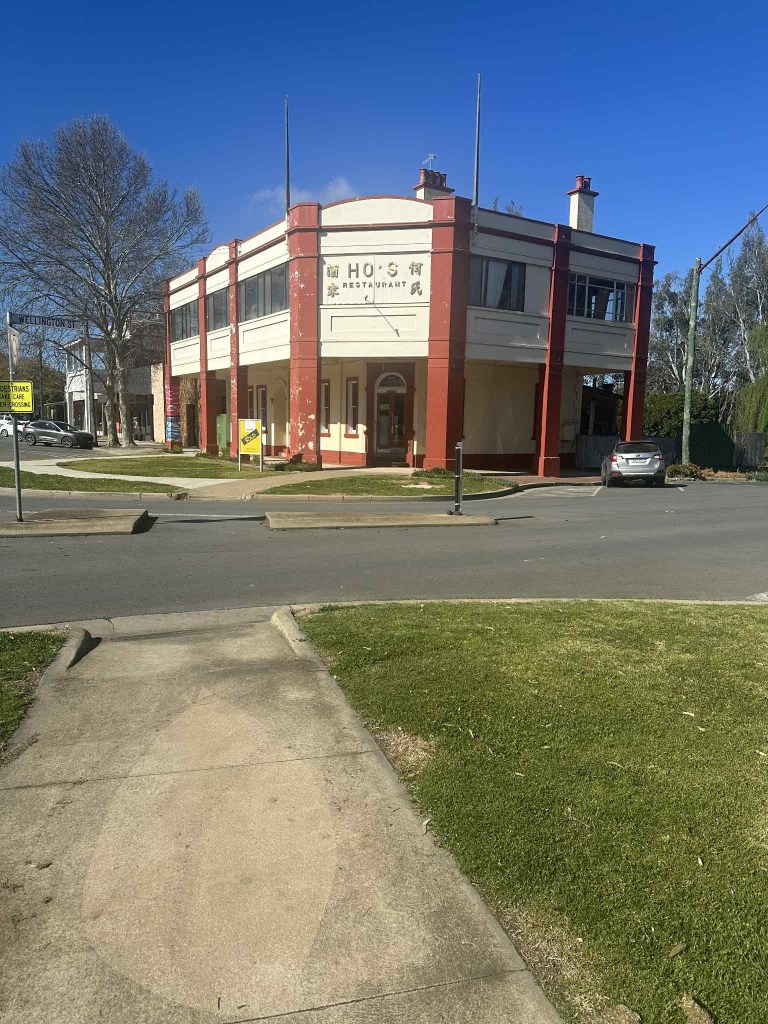
The building was purchased in 2025 with rumoured plans of a re-establishment of a restaurant there.
St George Inn –> Deniliquin Temperance Hotel –> St. George Hotel –> George Hotel
Was located at George & Cressy Street and the license for the hotel was granted to John Waring on July 5, 1860.
Mentioned in 1861 report as the site of a meeting regarding the separation of the Riverina from the colony of New South Wales.
Fredrick Marshall transferred the license of the Hotel to Decimus Lamb in 1867.
The Governor visited Deniliquin in July 1868 and the hotel was decorated appropriately for the occasion.
Fredrick Marshall applied to transfer the license of the hotel from Decimus Lamb to himself in May 1868.
Decimus Lamb was declared insolvent, he later turned up at the Court House Hotel and the Bush Inn.
Fredrick Marshall in 1870 announced the hotel was a Temperance Hotel which meant that while it was still a hotel, it did not serve alcohol to patrons.
Fredrick Marshall transferred the license of the hotel to George Lloyd on December 10, 1877.
George Lloyd was summoned for abandoning his licensed house on September 10, 1879, he did not appear, and his license was cancelled.
Mary Mahon applied for and was granted a license for the hotel on October 14, 1879.
In 1880, Mary Mahon’s daughter died of shock a day after falling into a boiler filled hot water at the hotel.
Former owners John Waring and Fredrick Marshall died in 1885 and 1886 respectively.
A hotel at the hotel was damaged at 2am one morning in 1888.
Mary Mahon died at the hotel on February 13, 1890, at the age of forty-eight, her death was said to be ‘peaceful and happy’ after a long and protracted illness.
D. Mahon was granted permission to carry on the license of the hotel until the license expired on June 30, 1890.
In 1895, a fire was reported at an old hotel in George Street, this may have been the St George, the fire did not result in the destruction of the building.
The building was deemed not tenantable and unsafe in March 1900 and could not be given a value.
Mr. J. Geraghty on June 21, 1906, sold his weatherboard property known as “The Old George Hotel” together with a two-storey stable built of slabs with the whole lot to be removed.
A. J. Whitelock brought most of the timber taken from the hotel and the site was later occupied by Collins & Sons’ cordial factory.
A 1908 article on ‘Early Deniliquin Memories’ reported that ‘ this old place was pulled down about three years ago’
The Pastoral Times reported in 1939 that few people remembered that there used to be a hotel on that site.
 Deni History